 Murat Bayral6m read
How designers get hired in 2026, according to the data
Open LinkedIn on a Tuesday and you get layoff posts all around and many people pivoting they are going all in on AI, and 10 MORE tools you have never heard of. Close the laptop. Make a coffee. Do nothing about it until 4pm.
I made a video about the 3 things I would pay attention to instead. Then I went and checked whether the research agreed with me. Most of it sharpened what I said. One study changed part of my advice, and I would rather correct it here than leave it sitting in a video.
Why panic content works so well on designers
Fear is not just loud. It is measurably effective. A meta analysis by Tannenbaum and colleagues pulled together 127 studies covering 27,372 participants and found fear appeals shift attitudes and behaviour with a moderate positive effect, and that the effect improves when the message includes an efficacy statement, meaning a specific action the person believes they can carry out.
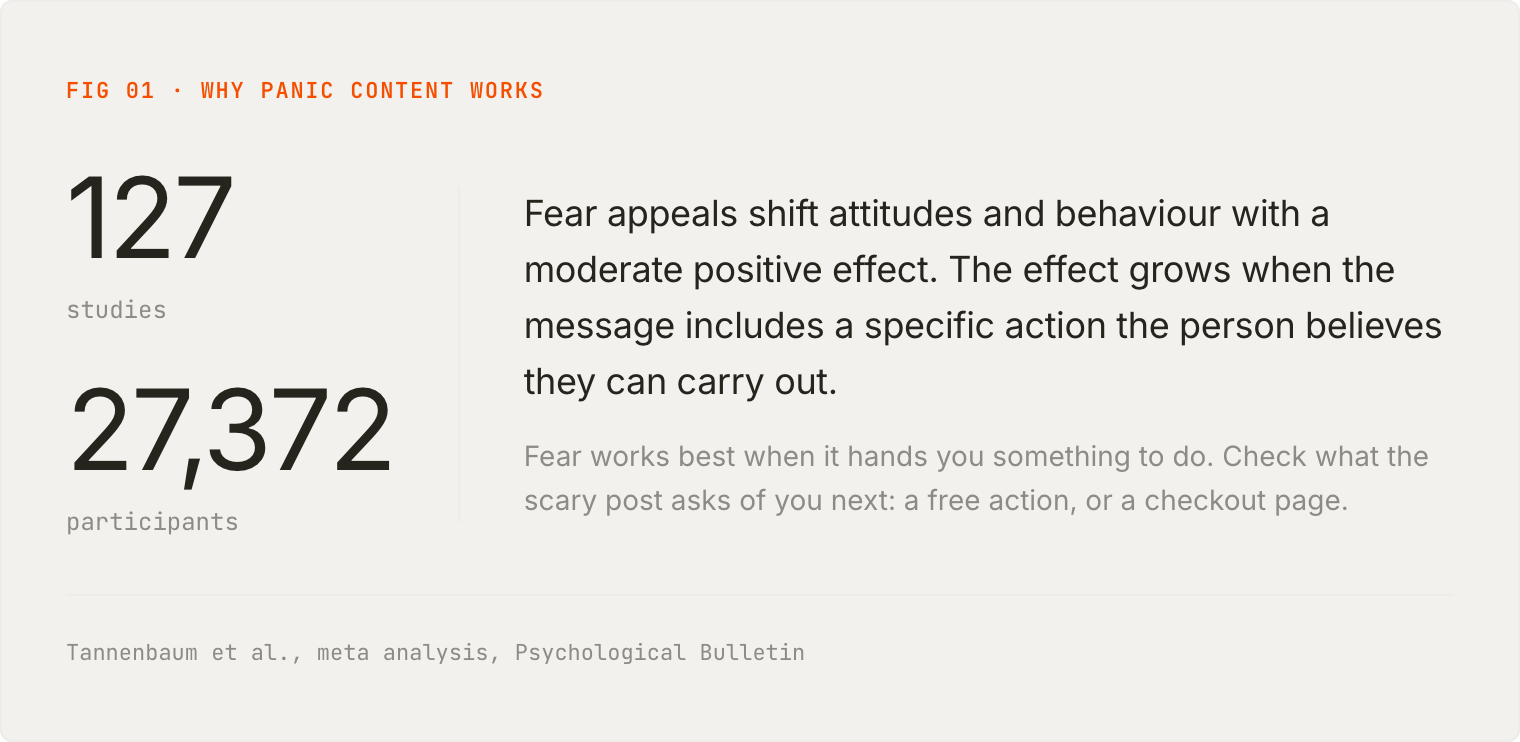
Sit with that second half. Fear works best when it hands you something to do. So the honest version of a scary message ends with a free action. The funnel version ends with a checkout page, and the action is the thing you buy.
That gives you a filter you can use for the rest of your career. Read any post that makes your stomach drop, then ask what it asks you to do next. If the only available action costs money, the fear was the product. If it hands you 20 free minutes of work, take it seriously!
How many applications a design job gets now
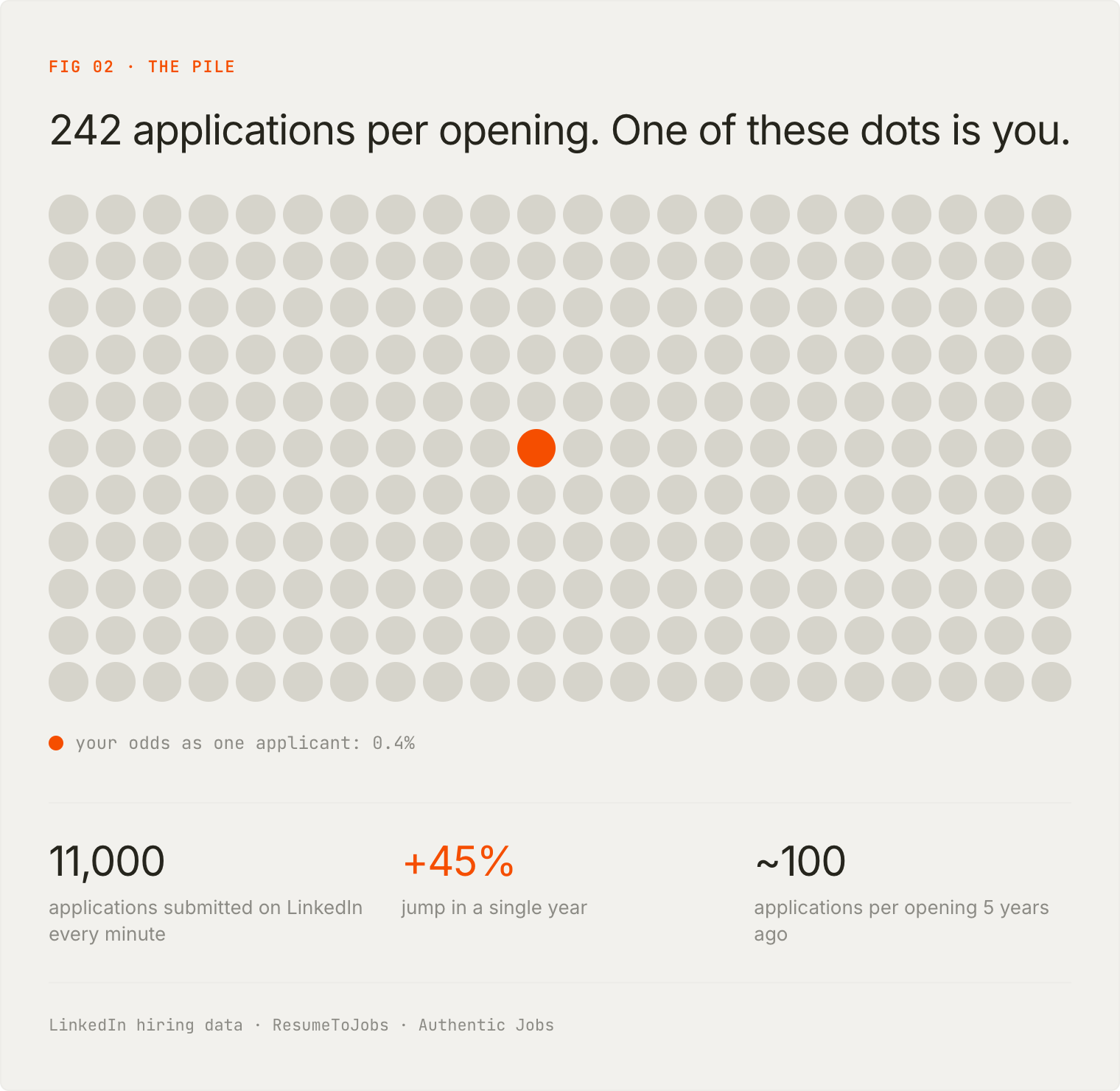
The scale of the pile has changed in a way most designers have not fully priced in. LinkedIn now sees roughly 11,000 applications submitted per minute, a 45% jump in a single year. The average opening now attracts around 242 applications, which works out at about a 0.4% chance for any single applicant, up from roughly 100 applications 5 years ago.
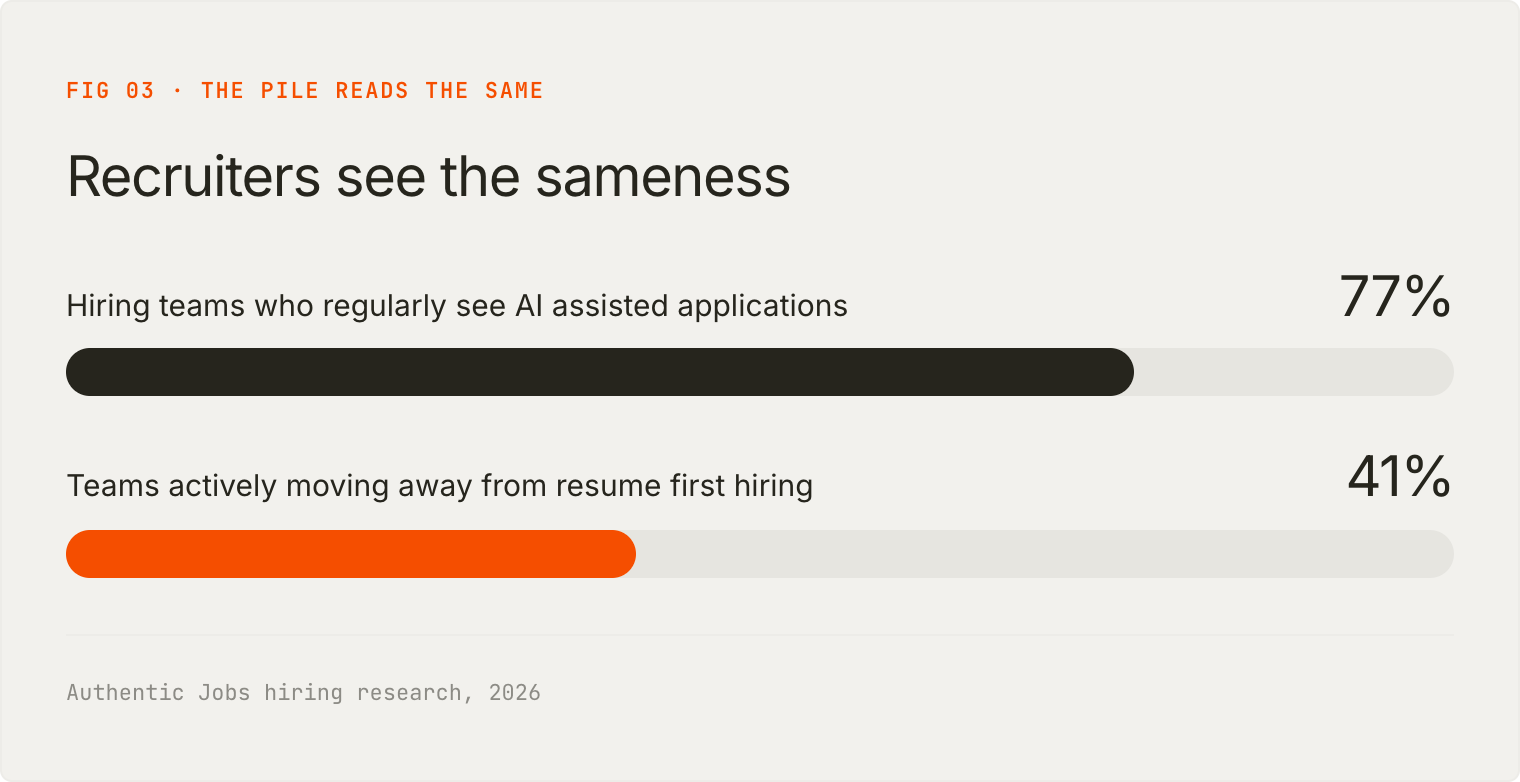
The pile also got more uniform. In the same research, 77% of hiring teams say they regularly encounter AI-generated or AI-assisted applications, and 41% are actively moving away from resume-first hiring. Recruiters describe the incoming work as overly polished outreach and resumes that all start to read the same.
In the video I said 100 people can make the same portfolio in 5 minutes. The data says I was being conservative, and it is not only the portfolio. It is the whole application.
What a referral is worth in numbers
Here is where the maths gets interesting for anyone worried about their odds.
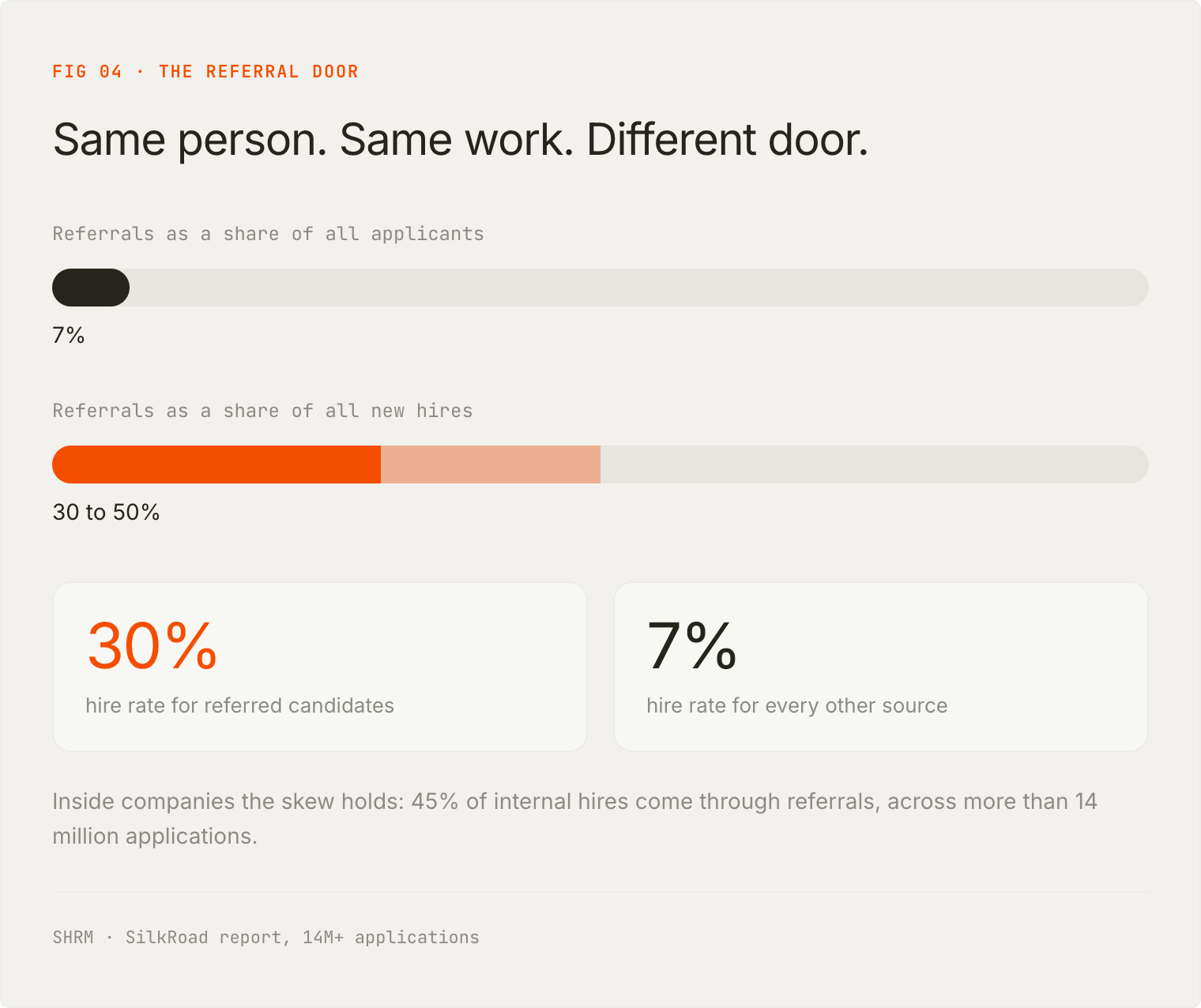
Referrals make up about 7% of applicants but account for 30 to 50% of all new hires in the US, and referred candidates get hired at roughly 30% against 7% for other sources. Inside companies the skew is just as steep: SHRM, using the SilkRoad report built on more than 14 million applications, found 45% of internal hires come through referrals.
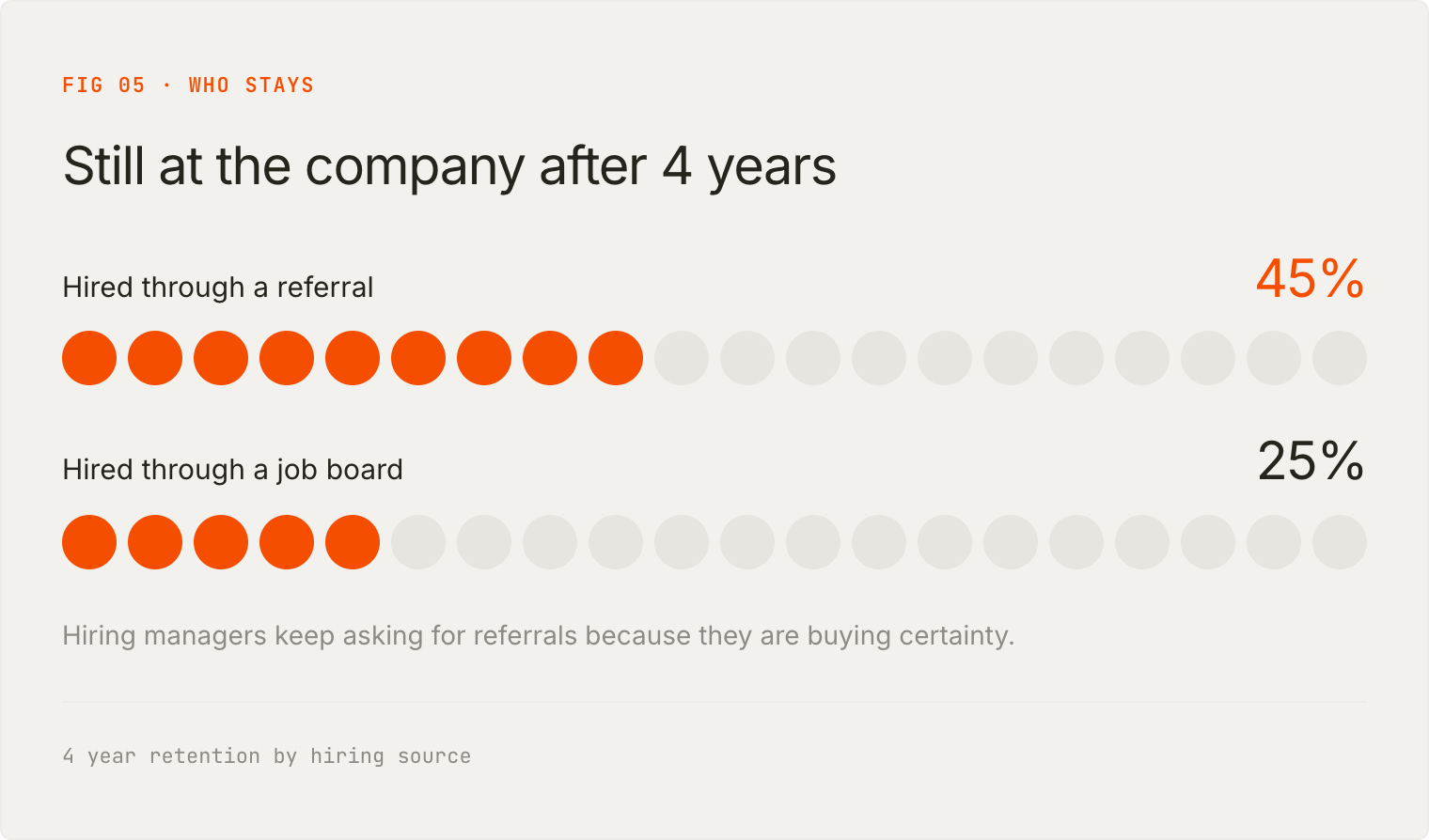
It holds after the offer too. 45% of referred hires are still there after 4 years, against 25% of people hired through job boards. That retention figure is why hiring managers keep asking. They are not being lazy. They are buying certainty.
Which people to actually message (this is where I was wrong)
At the end of the video I said write down your boss, your ex boss, and people you have worked with. Start with the people closest to you.
The largest study ever run on this says push one ring further out. Rajkumar and colleagues ran randomised experiments across more than 20 million LinkedIn users over 5 years, during which 2 billion new connections and 600,000 new jobs were created. The result: weaker ties drove more job moves than strong ties, but the relationship is non-linear, with diminishing returns once a tie gets too weak. The sweet spot sits in the middle. Mid-tier contacts, the ones you share around 10 connections with and rarely speak to, beat both your closest friends and near strangers, and the effect was strongest for highly digitised, software-heavy, remote-friendly roles.
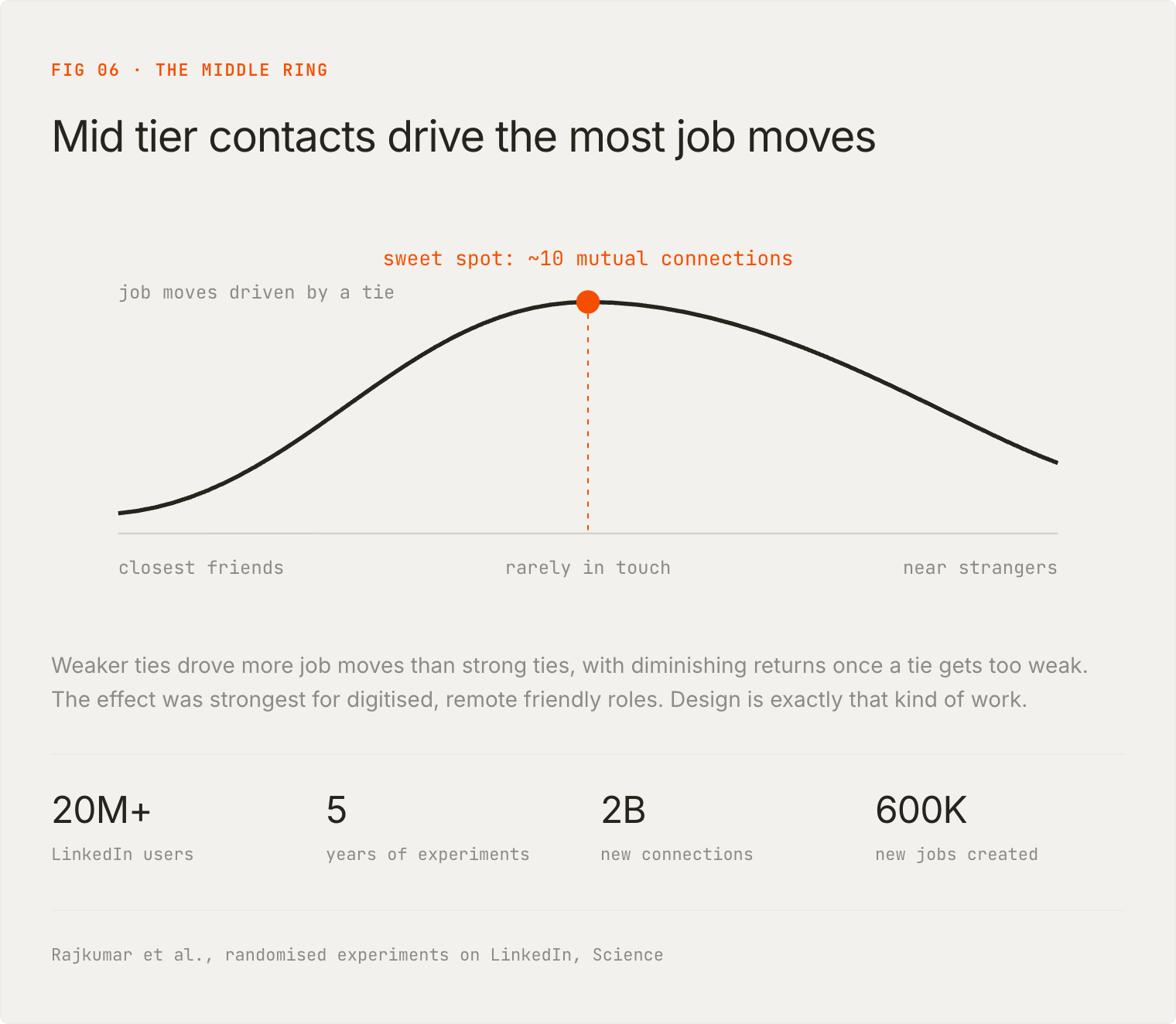
Design is exactly that kind of work. So your best friend in design, the one you speak to every week, is the least likely person to change your year. They already know everything you know. The designer you shipped one project with in 2023 and have not spoken to since is sitting in rooms you have never been in.
Put those people on the list. That correction takes 30 seconds and it is the highest-value thing in this post.
Why the slow way builds your eye faster
The last point in the video was to keep the slow lane, because AI removed the friction in the middle of the work and that friction is where judgement came from. There is a proper name for this.
Robert Bjork calls them desirable difficulties. These are conditions that slow you down during practice but produce far stronger long-term retention and transfer than smooth, fluent study, and the reason nobody chooses them is that performance during practice and actual learning can move in opposite directions. The most useful finding for anyone feeling behind right now: Deslauriers and colleagues found students in active learning environments learned more while feeling like they learned less, mistaking mental effort for failure while smooth lectures felt more effective and were not.
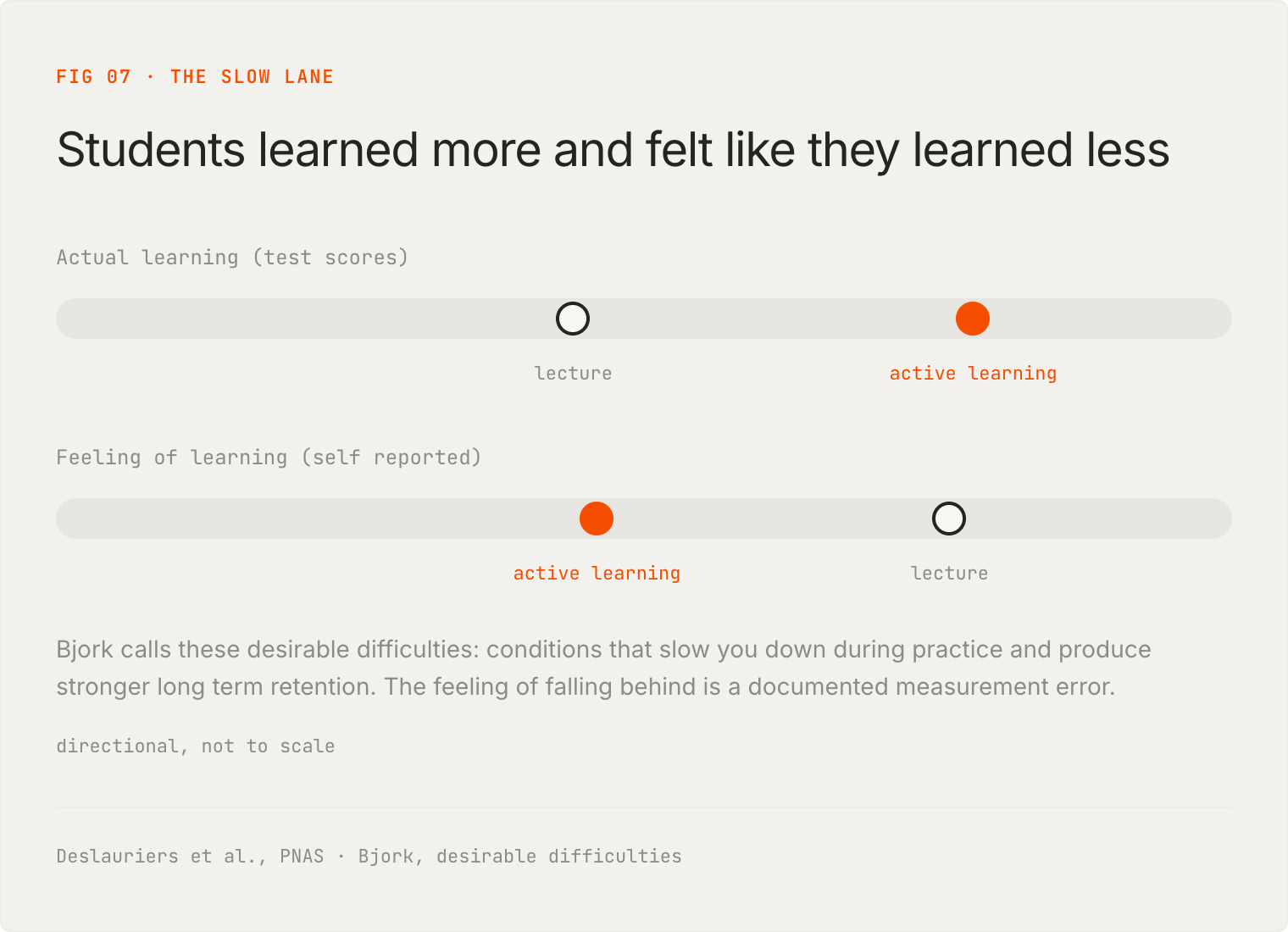
So the slow lane feels like falling behind. That feeling is a known measurement error, documented in a lab, in people doing the right thing.
Now the eye itself. Expert perception is a trained, physical thing. A meta-analysis of eye-tracking research covering 296 effect sizes from 819 experts and 893 novices found experts fixate faster on the parts that matter, waste fewer fixations on the parts that do not, and reach relevant information sooner. The extreme version: expert radiologists can spot abnormalities in a chest X-ray shown for 200 milliseconds, and chess experts recognise board patterns as chunks after thousands of hours. And it is trainable in a measurable way. In one study, discrimination training across 6 sessions raised sensitivity and cut the amount of viewing time people needed to tell stimuli apart.
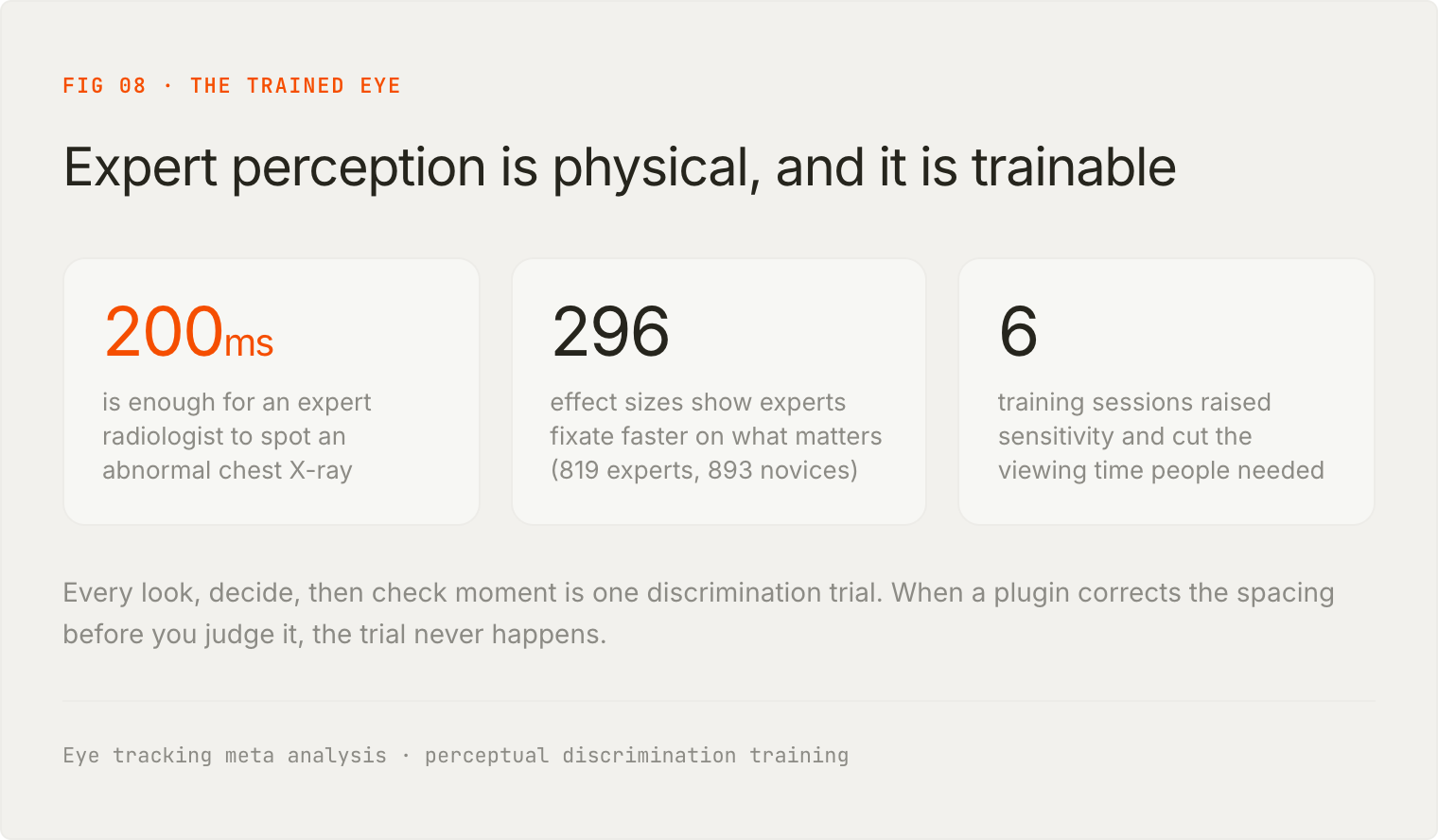
That 7px on one side and 27px on the other is a discrimination trial. Every time you look at a screen, decide yourself, and then check, you run one. When a plugin corrects it before you have judged it, the trial never happens and you bank nothing.
So keep the order: look, decide, then check. Looking after the answer is already on screen teaches you almost nothing.
The 20 minutes, updated
10 minutes writing names. Weight the list towards the middle ring: people you worked with once, share a handful of mutual contacts with, and have not spoken to in over a year.
10 minutes messaging. Name the specific thing you did together, say what you are working on now, and ask for nothing in the first message. A referral is a favour someone offers, not one you extract.
Then go back to whatever tool you were worried about this morning.
None of this research is new, which is the uncomfortable part. Granovetter published the weak ties idea in 1973. Chase and Simon described chunking the same year. Bjork named desirable difficulties in 1994. The tools got faster every year since. The way people get hired, and the way an eye gets trained, has not moved at all.